
Mapping Refillable Perfume Unit Cost: A Buyer's Checklist
A refillable perfume does not have a unit cost so much as a cost structure that moves every time a decision is taken. The primary vessel is bought once, the refill is bought repeatedly, and the interface between them decides how the whole system is filled, tested and shipped. Read a quote as a map of those three layers and the number stops looking arbitrary. This checklist links each driver to the decision a brand actually controls.
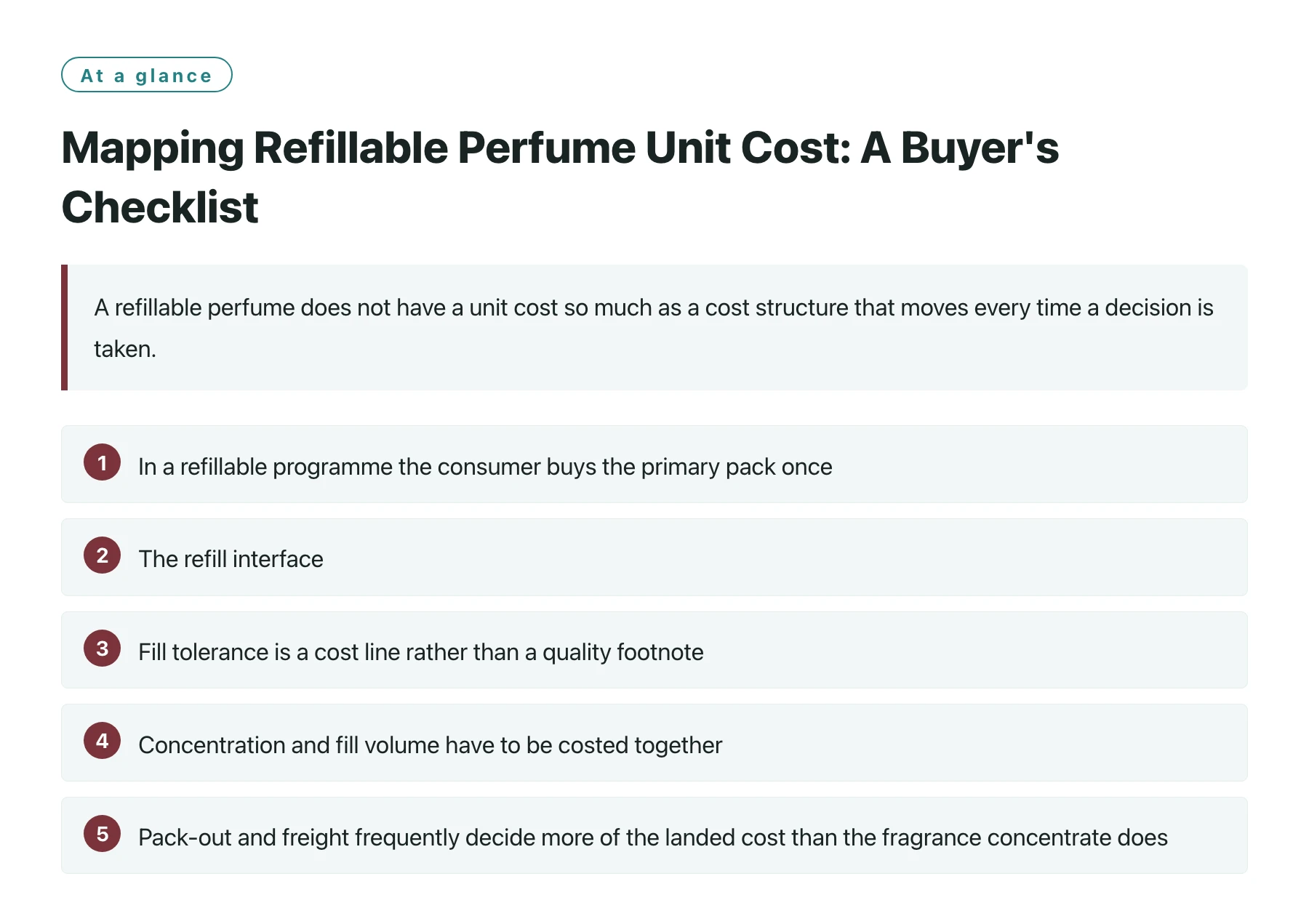
Key takeawaysIn a refillable programme the consumer buys the primary pack once, so component quality is amortised across every refill the system is designed to accept. · The refill interface, whether a threaded insert, a snap-fit cartridge or a screw-top decanter, largely determines the filling method, the leak-test standard and the tooling bill. · Fill tolerance is a cost line rather than a quality footnote, because a tight declared volume forces more weight checks and more rejected units on the line. · Concentration and fill volume have to be costed together, since a small, strong refill can carry a higher cost per fill than a larger, lighter one. · Pack-out and freight frequently decide more of the landed cost than the fragrance concentrate does, especially when the refill ships inside a set.
A first refillable quote usually arrives as one figure per unit, and that figure is almost always incomplete. It may exclude tooling, treat the refill reservoir as packaging rather than as a filled product, or assume a fill tolerance nobody has agreed to. When those assumptions surface later, the unit cost moves, and the movement is rarely in the buyer's favour.
The reason is structural. A conventional perfume is one pack and one fill. A refillable system is a primary vessel, a replaceable reservoir and an interface that has to keep working after the tenth or twentieth refill. Each layer has its own tooling, its own supplier logic and its own place in the quality plan.
This article treats the cost as a map rather than a total. It is written for the buyer who has to defend a price internally, which means being able to name the component that caused it and the decision that would change it.
Why the familiar cost formula stops working
On a standard bottle, cost is a chain: juice, pack, fill, pack-out, freight. Every link scales with volume, so doubling the order roughly doubles the spend. Refillable systems break that pattern because the most expensive part of the presentation, the outer vessel, is not consumed along with the product.
That single fact reorganises the whole exercise. A brand can justify more money in a heavier, better-finished primary pack, because the customer keeps it. At the same time the brand now owns a mechanism that has to survive handling long after the first fill, and the cost of proving that durability sits with the brand rather than with the consumer.
Before any of that is costed, it is worth fixing what the partner actually covers. A manufacturer that publishes its service scope, such as the official Xuelei website, is telling you where a single quote begins and ends, which is the first thing a cost model needs.
The three layers a quote has to separate
Ask for the price split into primary pack, refill reservoir and fragrance fill. A supplier that can only quote a blended figure is telling you something about how it costs its own work.
The primary pack carries tooling, decoration and assembly. The reservoir carries the interface and the seal. The fill carries the concentrate, the carrier and the filling labour. Once these are separated, comparisons between two suppliers become possible instead of rhetorical.
What the interface does to the rest of the line
A snap-fit cartridge and a screw-threaded refill demand different filling equipment, different torque settings and different leak tests. Choosing the interface therefore fixes a set of downstream costs before the vessel design is even finished.
This is why a refill programme is often cheaper to run as a single scope. Where one partner handles development, filling and packing, the interface is chosen with the line in mind, which is the usual arrangement behind one-stop fragrance manufacturing.
Cost drivers, and the decisions behind them
| Cost driver | What it actually depends on | Decision that moves it |
|---|---|---|
| Primary vessel tooling | Number of moulds, material, wall thickness | Whether the vessel is shared across the range or made exclusive |
| Refill interface | Thread or snap geometry, seal material, part count | Which refill mechanism the consumer has to handle |
| Fill tolerance | Declared volume and weighing method | How tight a declared net content the brand commits to |
| Fragrance dosage | Materials and concentration per fill | How much scent one refill actually delivers |
| Decoration | Method, number of passes, colour count | What the permanent pack needs versus the disposable refill |
| Pack-out and freight | Unit size, protection, set configuration | Whether refills ship alone, in sets, or in bulk |
Read down the third column: every row is a brand decision, not a factory decision. That is the part of the cost a buyer can genuinely negotiate.
Three places refill programmes quietly add cost
None of these three items appears spontaneously on a quote. Each one is a consequence of a choice made earlier, and each becomes visible only when the system is tested as a system rather than as a list of parts.
The leak test the mechanism forces
A refillable pack is opened and closed repeatedly, so the seal and the thread are working parts. Leakage or a cracked collar ends the customer's relationship with the format, which is why the test standard tends to be stricter than for a sealed bottle.
That strictness has a price: more samples, more units held back, and sometimes a change of seal material that was not in the original budget.
Decoration on two components instead of one
The permanent vessel and the refill both need to look like products, and they need to look related when assembled. Aligning colour and finish across two mouldings is a recurring cost, not a one-off design fee.
A useful cost-control move is to let the refill be plain where the vessel is decorated, provided the retail shelf still reads clearly.
The refill that has to behave like a package
A refill sold on its own needs its own labelling, barcode and artwork, and increasingly its own compliance story. Packaging rules in the European Union are moving toward reuse and refill, so the refill is treated as a package in its own right rather than as a bag inside a box [1].
Testing also moves with the format. Seal integrity, compatibility between the refill material and the fragrance, and long-term storage all belong in a test plan, and that plan is worth agreeing before tooling is cut [2].
If the numbers still look inconsistent between suppliers, the difference is usually in what each has left out. That gap is where a perfume quote can hide costs.
A practical discipline for a first refillable quote: ask for the price of the system at one fill, at five fills and at twenty fills. If the figure barely moves, the mechanism and its testing have not been costed separately, and that missing cost will reappear at tooling or at the leak test.
Sources
- European Commission: Packaging Waste and the PPWR —— EU rules on packaging and packaging waste, including the Packaging and Packaging Waste Regulation requirements on recyclability and design.
- SGS: Cosmetics, Personal Care & Household Testing —— Testing, inspection and certification services for cosmetics and personal care, including microbiological, stability and safety testing aligned with cosmetics GMP.
Frequently asked questions
Why is a refillable perfume not simply the bottle cost plus the juice?
Because the vessel is not consumed with the product. Its cost is spread across the refills it accepts, while the mechanism, the seal and the filling method carry their own tooling and their own testing. Costing the format as one bottle plus one fill hides the two layers that decide whether the system works.
Which component usually carries the most tooling cost?
The primary vessel, because it is the largest moulded part and often the most decorated. The refill interface is second, and it is the one buyers most often forget to cost separately. Both should appear as their own lines before a purchase order is raised.
Does a higher concentration always raise the cost per fill?
Not automatically. What matters is the amount of fragrance delivered per fill. A small, strongly dosed refill can cost more per fill than a larger, lighter one, and the comparison only becomes meaningful when the delivered dosage is stated in the same units.
How tight should the declared fill volume be?
Tight enough to be defensible and realistic for the line that will fill it. Every tightening of the tolerance adds weighing, rejection or rework. Agree the tolerance with the filling partner rather than borrowing a number from a different product.
Can a refill programme be costed before the vessel is designed?
Only as a range, driven by the interface and the material choice. A firm unit price needs the moulding, the decoration and the fill tolerance fixed. Treat any early single figure as a planning assumption, and ask which of the three layers it excludes.